


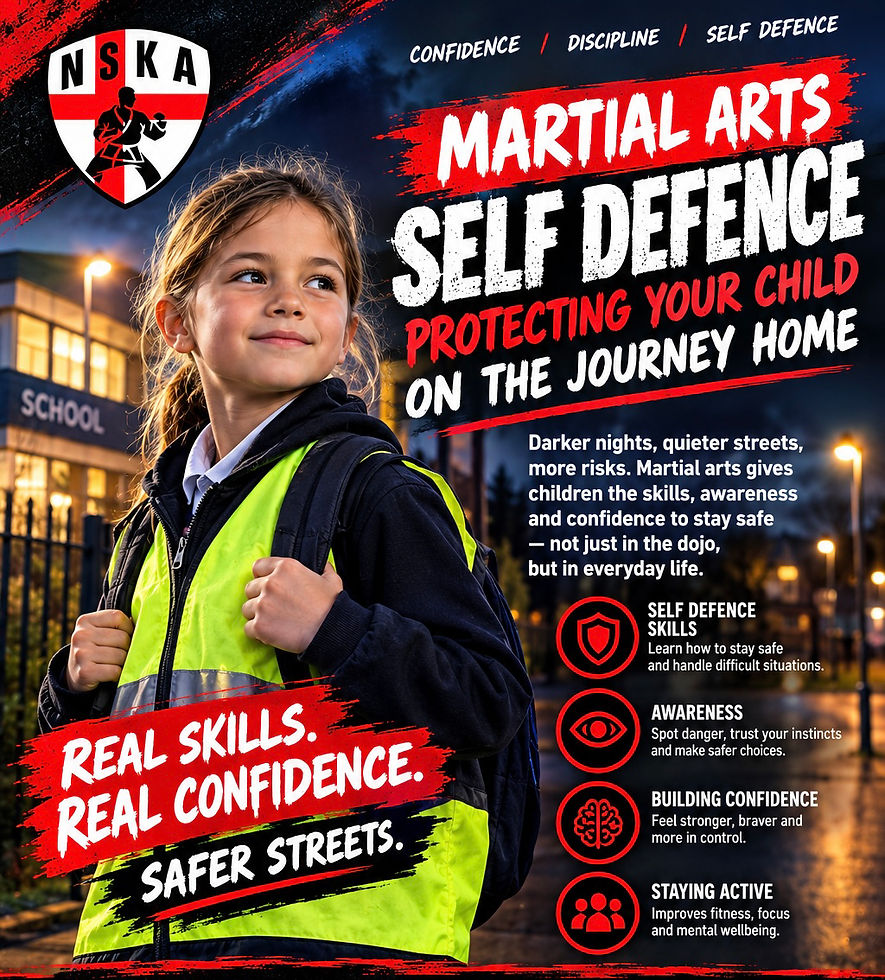
Keeping Children Safe in the 2026–2027 School Year: Self-Defence, Confidence & Staying Safe on Darker Evenings

As the 2026–2027 school year gets underway, parents naturally want their children to be confident, independent and, most importantly, safe.
For many families, the school journey changes dramatically as autumn and winter arrive. The mornings become darker, daylight disappears earlier and children who may have been walking home from school in bright sunshine can suddenly find themselves travelling in low light.
This is where children’s martial arts, self-defence training and personal safety education can play an important role.
At NSKA Karate & Kickboxing, we believe martial arts should be about far more than learning how to kick and punch. The right training can help children develop confidence, awareness, discipline, fitness and the ability to think clearly under pressure.
Why darker evenings matter
As the nights draw in, visibility becomes particularly important for children travelling to and from school. RoSPA recommends teaching children about being visible to road users, particularly during darker mornings and evenings, and suggests using clothing with reflective or fluorescent elements where appropriate. (RoSPA)
But staying safe isn't only about being seen.
Children can also benefit from understanding their surroundings, recognising when something doesn't feel right and knowing how to seek help.
That doesn't mean teaching children to be frightened of the world.
It means teaching them to be prepared.
Self-defence is about more than fighting
One of the biggest misconceptions about martial arts self-defence for children is that it is simply about learning how to fight.
Good self-defence education should teach children that avoiding confrontation is often the best option.
A child doesn't need to prove how tough they are.
Instead, martial arts can help develop:
Situational awareness
Confidence
Body awareness
Discipline
Communication
Decision-making
Physical fitness
Resilience
The confidence to seek help
The aim is not to encourage children to confront dangerous situations. It is to give them the confidence and awareness to make sensible decisions when something doesn't feel right.
Teaching children to be aware
Imagine a child leaving school on a dark winter afternoon.
They're wearing their school uniform, carrying a bag and perhaps looking at their phone while walking home.
One of the most useful lessons we can give them is simply:
Look up. Look around. Be aware.
Martial arts training can encourage children to pay attention to their environment rather than becoming completely absorbed in what is happening on a screen.
That awareness can extend beyond personal safety too.
Being aware around roads, car parks, strangers, busy areas and unfamiliar environments is an important part of growing independence.
Parents can reinforce this at home by talking calmly with their children about what they would do if they ever felt uncomfortable or unsafe. The NSPCC also recommends keeping communication open and making sure children know which trusted adults they can speak to if something worries them. (NSPCC)
Confidence can make a difference
Confidence doesn't mean believing your child can take on everyone.
Quite the opposite.
Healthy confidence can mean knowing when to walk away, when to ask for help and when something isn't right.
For children who are naturally shy or lack confidence, kids martial arts can provide a structured environment where they can gradually challenge themselves.
Learning a new technique.
Standing in front of the class.
Working with another child.
Completing a grading.
Trying again after getting something wrong.
These small achievements can build confidence over time.
And that confidence can extend beyond the martial arts club — into the classroom, playground, sports field and everyday life.
What should a child do if they feel threatened?
Every situation is different, and no martial arts class can guarantee that a child will never encounter danger.
The priority should always be getting away from danger and getting help, rather than winning a fight.
Children should understand that if they feel threatened, they should look for a safe opportunity to move away, attract attention and get to a trusted adult or safe location.
They should also know that carrying weapons is not a safe answer to personal safety. The NSPCC specifically advises against children carrying weapons for protection. (NSPCC)
This is where responsible children's self-defence training can be valuable: teaching awareness, confidence and appropriate responses rather than encouraging aggression.
Martial arts builds more than self-defence skills
There are benefits to martial arts that go well beyond personal safety.
Regular karate and kickboxing for children can provide opportunities to improve fitness, coordination, concentration, discipline and confidence.
Children also learn to listen to instructions, respect others and work towards goals.
And importantly, martial arts can be enjoyable.
The NSPCC notes that structured martial arts training can be appropriate for children from around six as their physical, emotional and social skills develop, provided activities are developmentally appropriate and appropriate safeguarding measures are in place. (NSPCC Sport)
That is why choosing the right martial arts club matters.
Parents should feel comfortable asking clubs about their safeguarding procedures, instructor training, supervision and how children's wellbeing is prioritised. The NSPCC provides guidance for parents choosing martial arts and combat sports clubs. (NSPCC)
A safer journey starts before the journey
There are simple things parents can do this autumn and winter alongside self-defence training for kids:
1. Make sure children can be seen.
Consider reflective elements on coats, bags or clothing during darker journeys. (RoSPA)
2. Talk about their route home.
Discuss where they should go if they feel uncomfortable or need help.
3. Encourage awareness.
Teach children to pay attention to their surroundings rather than becoming distracted by phones.
4. Identify trusted adults.
Make sure your child knows who they can approach if they need help.
5. Talk, don't frighten.
Safety conversations should build confidence rather than make children afraid to leave the house.
6. Consider children's martial arts.
A structured karate or kickboxing class can help develop confidence, discipline, fitness and awareness in a positive environment.
Give your child skills for life
The 2026–2027 school year is about more than homework and school performance.
It's about helping children become confident, capable and resilient young people.
At NSKA, we believe martial arts should give children skills they can take with them everywhere.
Confidence.
Discipline.
Awareness.
Fitness.
Respect.
Self-defence.
Not to make children look for confrontation — but to help them have the confidence to avoid it.
Looking for children's martial arts in Norwich or Norfolk?
If you're looking for kids karate, children's kickboxing, martial arts for children or self-defence classes in Norwich and Norfolk, NSKA Karate & Kickboxing welcomes children aged 6+ and all abilities.
Whether your child is naturally confident or needs a little encouragement, martial arts can provide a positive environment where they can learn, develop and grow.
Don't wait until your child needs confidence. Help them build it now.
🥋 NSKA Karate & Kickboxing
👊Children 6+
📍Norwich & Norfolk
💪Build confidence. Learn discipline. Develop real skills.
Interested in getting your child started? Send NSKA a message today to find out about classes, availability and how your child can get involved.
Comments